Why baby nail care is genuinely hard
Baby nails grow faster than most new parents expect. Newborns can need a nail trim within days of birth.
Some are born with nails long enough to scratch themselves in the womb. After birth, most infants need trims every one to two weeks. That's a lot of clipping sessions to get through.
The nails are tiny
We're talking about fingernails barely wider than a credit card's edge on a newborn. Getting a clipper blade precisely aligned on something that small requires steadiness that most new parents — on four hours of sleep— simply don't have.
The fingers won't stay still
Even a sleeping baby twitches. The Moro (startle) reflex causes sudden arm movements without warning.
You're aiming at a moving target, at scale. That's not a personal failure — that's just physics.
The stakes feel enormous
Cutting too deep means blood. On a tiny person you'd do anything to protect. The fear is completely rational, even when the actual risk is lower than it feels. Most parents who've nicked a finger describe the emotional aftermath as far worse than the physical reality.
Why nails need frequent trimming
Baby nails grow approximately twice as fast as adult nails. The reason: higher metabolic rate and faster cell turnover in growing infants. Expect weekly trims for newborns, tapering to every 1–2 weeks as they grow older.
In this guide
What to do right now
Apply gentle, steady pressure with a clean cloth or gauze. Hold for 2–3 minutes without peeking. Do not use a bandage on a small baby's finger — it can loosen and become a choking hazard. If bleeding hasn't slowed in 5–10 minutes, or you notice redness or swelling in the following days, contact your pediatrician.
What if I cut too deep? What actually happens.
Let's go straight at the fear. If you nick your baby's finger while clipping, here is what actually happens:
It bleeds. Baby fingertips have strong blood supply. Even a small nick can look alarming because of how quickly blood appears. But fingertip cuts are almost never dangerous.
Your baby will cry. This is usually more about surprise and sensation than about pain. It will feel awful. It is not an emergency.
And then it's over. The bleeding stops quickly — typically within a few minutes of gentle pressure. The finger heals fast. There is no lasting injury.
Every method compared honestly

How the safety slot works
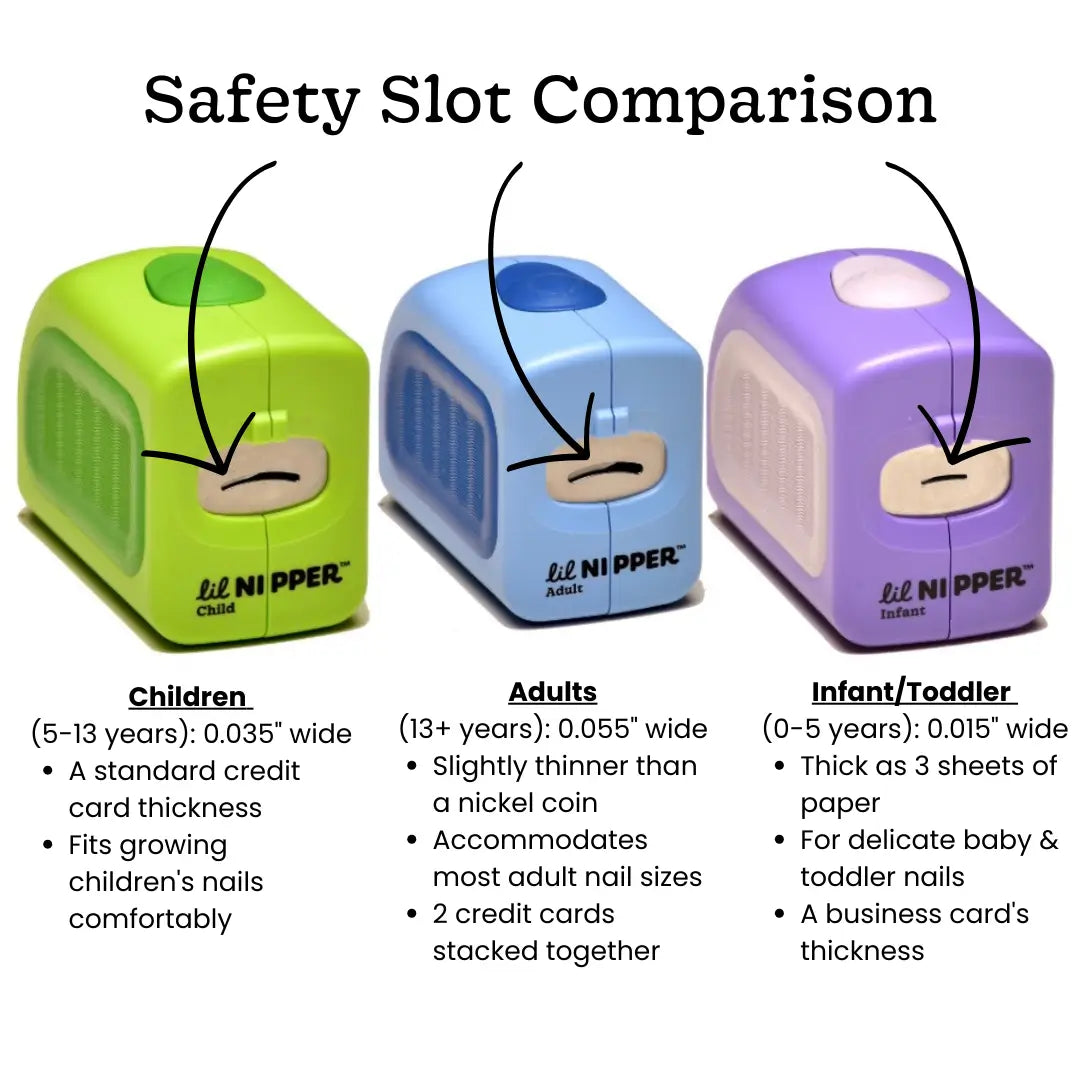
The slot is exactly wide enough to accept a nail - and nothing wider. The surgical-grade steel blade operates inside the device, behind the slot opening. Skin cannot enter the space where the blade is. The safety is built into the geometry of the device itself.
The blade shaves, not files, clips, grinds or snaps.
It creates a clean edge without
shredding or tearing. This is an important
distinction from some other baby nail tools on the market.
LED light
Built in-see clearly even in dim conditions
Clipping compartment
Catches nail trimmings so they don't
end up in the crib or on the floor.
USB rechargeable
No batteries to track down or replace.
Lifetime warranty+ 90-day guarantee
Separate policies. The guarantee is for satisfaction; the warranty for the product.
About the operational hum
The Lil Nipper produces a purposeful humming sound when running. This is intentional — the sound indicates the clipper is engaged and working. Many parents find this reassuring. Some babies come to associate the sound with the clipping routine, making future sessions easier as they learn what to expect.

What size do you need
The Lil Nipper comes in three sizes. The difference is the width of the safety slot — which determines what nails can fit through. Choosing the right size matters for both safety and effectiveness.
About toenails
The Lil Nipper does not work on thick adult toenails. For children and toddlers, it often works fine — children's toenails are thinner. The simple rule: if the nail fits into the slot, the clipper will work on it.
Step-by-step: fear-free baby nail clipping
Technique matters as much as the tool.
Choose the right moment
Clip nails when they are dry and firm — not right after a bath. Wet nails are softer and more likely to bend or tear rather than clip cleanly. The best windows are before a bath, during feeding when baby is calm and occupied, or during a deep sleep. Avoid nail care when baby is hungry, overtired, or just waking up.
Set up good lighting
The Lil Nipper has a built-in LED, but additional overhead or task lighting helps. Nail care in dim conditions is harder than it needs to be. This is one of those simple things that makes a real difference.
Stabilize the hand
Hold your baby's hand with your thumb under their palm and your other fingers curved over the back of their hand. This gives you control of the wrist and reduces unexpected movement. This is the grip most parents get wrong.

Start with one nail
No rule says you have to do all ten at once. Start with one. If baby is cooperative, continue. If they're squirmy, clip one nail and come back later. One nail at a time, done calmly, beats ten nails done in a stressful rush.
Press firmly into the slot
The nail needs firm, steady pressure into the slot — then hold for 2–3 seconds. Let the clipper do the work. This is where most new users go wrong. Don't rush it. If you don't feel the clip, press slightly more firmly and hold a beat longer.
Take breaks freely
Two nails at bathtime, two more before bed — that's fine. Spreading the task across multiple short sessions reduces stress for both of you.
10,000+ Happy Customers
Real Parent Stories
Baby Nail Care By Age
Newborn nails are paper-thin, sometimes curved inward, and grow faster than most parents expect. Some babies arrive with nails already long enough to scratch their own face. Don't panic — this is normal. Filing is the gentlest approach at this stage. An emery board has no blade and zero risk. If you do clip, use the Infant size only — the 0.015" slot is sized specifically for these delicate early nails. Timing is everything: many newborns sleep deeply enough that you can work through all ten fingers without a single stir. Before a bath is ideal — dry nails clip cleanly. Wet nails after a bath bend and tear rather than cut.
This is the stage that surprises most parents. Nails grow fast — weekly trims are genuinely common, sometimes more. Your baby is becoming more alert and aware, which means timing matters more than it did in the newborn weeks. A sleeping baby is your best window. During feeding is the next best option — baby is occupied and relatively still. Post-bath is the worst time despite what you may have read — soft nails don't trim cleanly. The Infant size Lil Nipper is still the right choice here. If your baby startles or pulls their hand away mid-clip, stop, take a breath, and come back to the next nail in a few minutes.
Baby is grabbing everything now — your hair, your glasses, the dog. Overgrown nails scratch more frequently at this stage because tiny hands are in constant motion. You'll notice the marks on their cheeks. That's your reminder. The sensory experience of nail care is also registering more consciously now. Some babies fuss at the sound or sensation. Some don't care at all. If yours fusses, don't force it — do two nails and stop. Consistency over time matters more than completing all ten in one sitting. Babies who grow up with a regular nail care routine at this stage typically become the easiest toddlers to work with.
Toddlers have opinions about everything. Nail care is no exception. The good news: toddlers who've grown up with the Lil Nipper from infancy accept it as completely normal — it's just part of life, like brushing teeth. If you're introducing it now, distraction is your best tool. A short video, a favorite snack, a song they love — anything that occupies their attention for 60 seconds. Break the session into pieces. Two nails while they're watching something. Two more after dinner. There's no rule that says all ten must happen at once. If they're old enough to understand, let them hold the device first so it's familiar. At 15 months, they are able to start using the Lil Nipper independently!
This is the independence window. Many children at this age want to do things themselves — shoes, snacks, nail care. The Lil Nipper's patented safety slot makes supervised self-clipping safe at this age too. The skin cannot enter the blade area regardless of how the child holds it. Start by doing it together — let them press the device while you guide the position. Within a few sessions, many children in this age range can manage their own fingernails with just light supervision. This builds real confidence and removes the daily battle entirely. Use the Infant size through age 5. Check nails weekly — children's nails grow fast and the scratching stage doesn't fully end here.
Transition to the Child size at age 5. The slot width is 0.035" — wider than the infant slot to accommodate nails that have thickened through the preschool years. Most children in this range can clip their own fingernails with minimal or no supervision. The Child size grows with them through elementary and middle school. If your child has been using the Infant size and you notice the clip feels incomplete or the nail is harder to seat in the slot, that's your sign to size up. The Child size also works for many children's toenails — the simple rule applies here too: if the nail fits in the slot, it will gently trim it.
Related Guides
SHOP NOW-

Baby Nail Care 101: Everything New Parents Need to Know
READ BLOGComplete guide for new parents: Learn why baby nail care is essential, which tools are safest, and get step-by-step tips for a stress-free trim of your infant’s fingernails and toenails.
-

Trimming Kids' Nails: The 5 Biggest Challenges and How Lil Nipper Makes it a Breeze
READ BLOGAre you struggling to trim your kids' nails? Discover the five biggest challenges and how the Lil Nipper makes it a breeze. It offers safe, easy, and stress-free nail care for little ones.
-

When Your Toddler Fears Nail Clippers: Child Psychologist's Approach
READ BLOGYour toddler screams at nail clippers? You're not alone. Child psychologist reveals why it happens and exactly what works.
-

Baby Nail Care Made Safe: The 2026 Parent's Guide
READ BLOGTraditional baby nail clippers are terrible. Here's what actually works: electric clippers with safety tech that makes cutting skin impossible.
-

35 Twin Baby Care Hacks: Real Time-Savers
READ BLOGGet 35 proven twin baby care hacks from real parents. Find time-saving tips for feeding, diaper changes, sleep, and grooming to help exhausted parents of multiples.
-

Baby to Teen Nail Care: What to Use at Every Age
READ BLOGNewborn nails to squirmy tweens — here's exactly what nail care tools to use at every age, what to avoid, and when to size up. A real parent's guide.
-

My Toddler Is Terrified of Nail Clippers — Here's What Helped
READ BLOGNail time means tears, wrestling, and stress — until it doesn't. A child psychologist explains exactly why toddlers fear nail clippers and what to do about it.
-

New Parent Anxiety: The Complete Guide to Managing First-Time Parent Fears
READ BLOGNew parent anxiety is real — and it's almost universal. Here's what's normal, what's not, and some practical tools to help you feel like you know what you're doing.


15 questions parents ask most. answered directly.
Frequently Asked Questions
How often should I cut my newborn's nails?
Most newborns need nail trims every 1–2 weeks. The clearest sign: nails
long enough to scratch their face.
What is the best time to clip baby nails?
During feeding works. Avoid
when hungry or overtired. When using an electric device, the nails are better when hardened.
Is it safe to bite my baby's nails?
Common in the newborn weeks. Pediatricians advise against it due to
bacteria transfer. Very common practice.
What do I do if I accidentally cut my baby's finger?
Gentle steady pressure with clean cloth for 2–3 minutes. No bandage — choking hazard. Call pediatrician if bleeding doesn't slow in 5–10 minutes.
When can babies start clipping their own nails?
With a safety-slot clipper, supervised self-clipping is possible around 18
months.
Do electric baby nail clippers actually work?
Yes — technique is essential. Press nail firmly into slot, hold 2–3 seconds and pivot slightly. Most failures are from not pressing nail firmly enough into the slot.
What makes the Lil Nipper different?
Patented safety slot and trimming mechanism— skin is protected from the internal blade. Trims/shaves,
does not file. LED light, nail compartment, USB rechargeable. 90-day guarantee + lifetime warranty.
Why does the Lil Nipper make a sound?
The hum is intentional — confirms the clipper is engaged and working.
Many babies come to associate it with the clipping routine...much like an electric toothbrush. Great for those with vision loss.
Can I use it on my toddler's toenails?
Absolutely. If the toenail fits in the slot, it will trim it. The Lil Nipper does not work on
thick adult toenails.
Are nail files safe for newborns?
Yes — safe approach for newborns in first few weeks. Slow, but zero risk.
My baby hates nail clipping. What can I do?
Change timing first. Distraction helps — video, snack, song,, during feeding time. Break into 2-nail sessions. Consistency over time helps most.
Which Lil Nipper size for my newborn?
Infant/Toddler size (ages 0–5). Slot is 0.015" — about 3 sheets of printer paper.
Can I use the infant Lil Nipper on my 6-year-old?
It really depends on the thickness of your child's nail. Usually by 6, their nails have thickened. The infant slot may be too narrow. Use the Child size (0.035"), ages 5–13).
How do I know when nails need cutting?
Scratches on their face from their own hands. Nails extending past fingertip or catching on fabric.
Does the Lil Nipper come with a warranty? Does it require batteries?
90-day satisfaction guarantee + lifetime warranty. Two separate policies. Batteries are built-in and rechargeable. Free US shipping on all orders.

Free us shipping
Lil Nipper — Infant (Ages 0–5)